Sculptural Lighting at the Edge of Attention
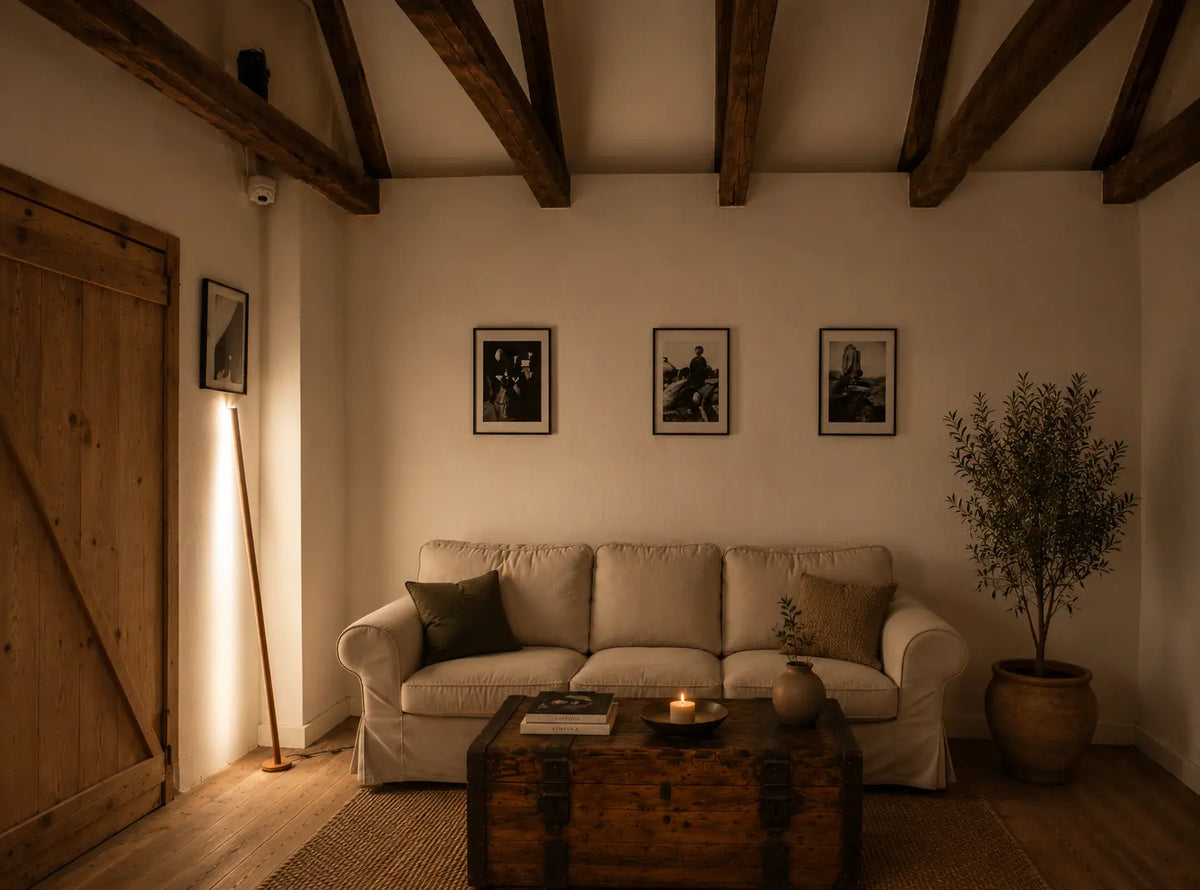
A long wall behind a low sofa can be strangely unresolved. Nothing may be wrong with it. The plaster is even, the furniture is placed with care, the proportions are acceptable. Yet the eye travels across the length of the wall without finding a point from which to read it. The room feels furnished, but not quite measured.
Adding a large object often solves the problem too quickly. A painting may occupy the surface. A shelving system may divide it. A heavy floor object may stop the eye by force. These decisions can be valid, but they change the room by claiming territory. There is another possibility: a vertical presence narrow enough to leave the wall intact, but precise enough to give the eye a point of orientation.
This is where sculptural lighting becomes more than a question of form. Its value is not that it resembles sculpture, nor that it announces taste. Its value lies in a more exact spatial task: it can become a visual anchor while remaining at the edge of attention. The object is noticed, but the room is not reorganised around its ego.
Presence begins as a measure
Sculptural presence is often misunderstood as intensity. In interiors, intensity is rarely the most durable quality. A room is lived with from different distances, at different speeds, and in moments when no one is consciously studying it. A strong object that must be looked at every time may become tiring, even if it is beautifully made.
A more useful presence begins as a measure. A vertical element can help the height of a wall become readable. A small base can clarify where the floor plane ends. A slim illuminated body can mark the interval between furniture and architecture without filling it. These are modest effects, but they change the way a person understands the room while crossing it.
The distinction matters because a visual anchor is not the same as a centrepiece. A centrepiece asks to be approached frontally. An anchor can work from the side. It remains available to the eye without interrupting conversation, movement, reading, or the ordinary disorder of a room in use. Its authority comes from proportion, not display.
Shadow is part of that authority. Without darker areas around it, a lit object loses scale and becomes a floating brightness. With too much contrast, it becomes theatrical. The useful condition is more controlled: enough shadow for the object to have contour, enough light for the adjacent surface to be understood, and enough restraint for the rest of the room to continue breathing in its own rhythm.
A sign must remain legible without becoming central
An architectural sign in a domestic room should not behave like signage. It does not need to instruct. It needs to be legible. The difference is subtle but important. A sign that instructs pushes itself forward. A sign that is legible gives orientation and then allows attention to move elsewhere.
This is why scale alone cannot determine success. A small object may dominate if its shape, brightness or finish insists too strongly. A taller object may remain calm if its width, position and light are disciplined. The question is not whether the object is visible. It must be visible. The question is whether its visibility clarifies the surrounding space or competes with it.
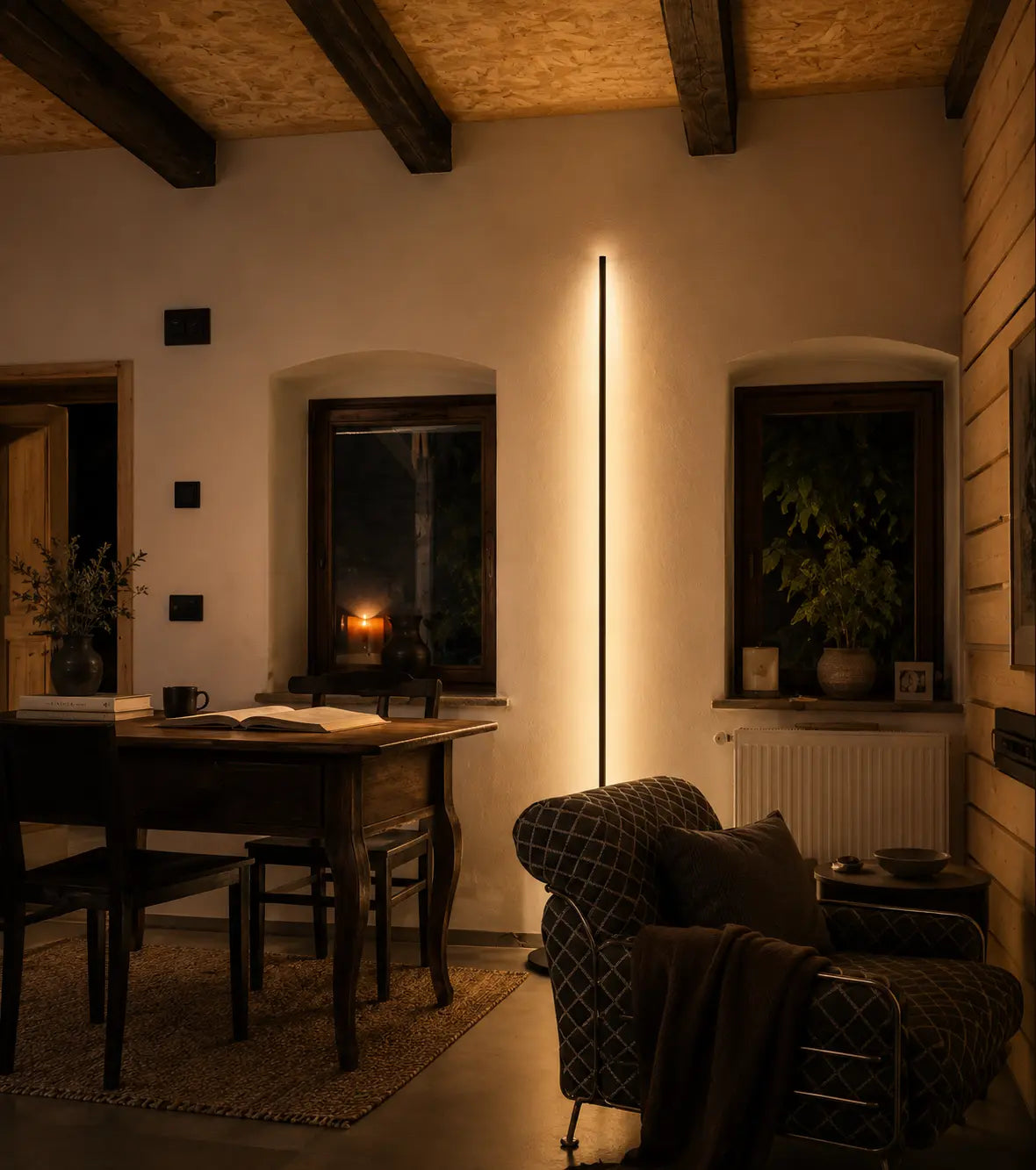
The Gica Contra Floor Lamp 150 offers a concrete way to read this condition. It is first a sculptural object: a vertical figure 1500 mm high, with a profile only 20 mm wide and 20 mm deep. Its geometry comes from the exclamation mark, and its origin belongs to a personal dialogue between Tommaso Cristofaro and his son Riccardo, where a child’s determined “No” became an affirmation of identity rather than conflict.
Those facts matter here because they show how a strong sign can be reduced without being emptied. The exclamation mark is usually emphatic on a page. In this object, its force is disciplined by narrowness and proportion. It can be read as a vertical mark in space without requiring the room to become a stage for it. The personal story remains present, but it does not ask the interior to perform sentiment.
The same principle can be followed beyond a single object. A previous journal essay on a lighting installation shaped by restraint considers how light can acquire meaning by limiting what it claims. At a domestic scale, the consequence is more intimate. The sign must remain close enough to daily life to be useful, but composed enough not to consume it.
The room continues around it
The lived test of sculptural lighting occurs when no one is admiring it. A person enters with a book, crosses to a chair, sets down a glass, adjusts a curtain. The object remains in the room, but it does not demand a pause. It marks a place. It gives the wall a finer scale. It allows the darker corner beside it to remain part of the composition rather than an absence to be corrected.
This kind of presence is especially relevant in rooms that already contain good furniture. A sofa, a chair and a low table may establish use, but not always orientation. The missing element is sometimes not another surface or another decorative layer, but a vertical note that relates the human body to the height of the room. A person standing near it does not feel that the object has taken over the wall. The wall has simply become easier to understand.
There is a practical consequence for placement, though it should not become a formula. A sculptural lamp used as a visual anchor needs enough surrounding space for its outline to be read. Too close to visual clutter, it becomes another item. Too isolated, it can become ceremonial. The better position is often one in which the object participates in an existing condition: beside the length of a wall, near a reading chair, close to a passage where the eye meets it obliquely before entering the room fully.
For readers considering scale and placement more broadly, the atelier’s guide to choosing a sculptural floor lamp for a space addresses those decisions in practical terms. Here, the narrower point is presence. The most effective anchor is not always the most prominent object. It is the one that remains readable after attention has moved on.
Return to the long wall behind the low sofa. It has not been filled. It has not been corrected with spectacle. A slender vertical object near it changes the reading of the plane because the eye now has a measure, and the measure has restraint. The room still belongs to its furniture, its surfaces, its shadows and the people moving through it. The difference is that its proportions have become quietly legible.