Daily Lighting Rhythm at the Edge of Use
The rim of a ceramic cup on a desk is easy to read at noon. Its shadow is short, the table surface is even, and the small circular line belongs to the practical world of work. Later, under a single overhead fitting, the same cup can appear harder than it needs to be. The edge brightens, the table reflects more than the hand requires, and the room seems to continue asking for attention after the task has ended.
A daily lighting rhythm begins in such minor changes. It is not an aesthetic schedule imposed on a room. It is the adjustment of visual demand as use changes. A surface that needs to be clear at midday may need to recede at night. A passage that must be legible when people arrive may require only a low orientation once the house is settled. The point is not to make every hour beautiful. It is to let each hour ask for the right amount of visibility.
This distinction matters because interiors are often lit as though use were constant. The same brightness that helps with a document can become tiring during a conversation. The same ceiling light that makes cleaning simple can flatten a room in the evening. Light throughout the day should not be treated as a continuous level to be maintained. It should be allowed to change its responsibility.
The hour changes the demand placed on a surface
Morning light usually arrives with direction. It touches one side of a wall, leaves another side cooler, and makes furniture readable without making every object equally important. Even when daylight is modest, it often gives the room a hierarchy: window, floor, table, chair, wall. The eye accepts this order because it changes gradually and because it belongs to the exterior conditions of the day.
Artificial light can become crude when it ignores that hierarchy. A bright fitting placed at the centre of the ceiling may answer the practical question of illumination, but it often removes the gradation that made the room easy to inhabit. Corners become equally exposed. Vertical surfaces lose depth. The difference between a working zone and a resting zone becomes less clear.
The useful question is therefore not how much light a room contains, but which surfaces should remain active at a given hour. During a meal, the table may need a clear field while the upper walls can fall back. During reading, the page requires precision, but the rest of the room does not need to compete. During the late evening, orientation may be more important than detail. A person should be able to move through the room without being made to inspect it.
A daily lighting rhythm depends on this selective attention. It recognises that comfort is often produced by reducing unnecessary clarity. The eye can rest when it is not required to measure every shelf, handle, frame and joint with the same intensity.
A lighting routine should mark transitions, not fill time
The word routine can suggest repetition without thought. In lighting, a good routine is more exact than that. It marks the passage from one kind of use to another. The change from afternoon work to evening occupation is not only a change in brightness. It is a change in posture, pace and distance. People sit differently. They move less directly. They stop needing the far corner of the room to be as visible as the chair beside them.
For this reason, a lighting routine should not be built around the idea of replacing the sun after sunset. Evening lighting has another role. It can reduce the field of attention, separate the active surfaces from the passive ones, and allow parts of the room to become background again. The result is not darkness as an effect. It is the removal of excess emphasis.
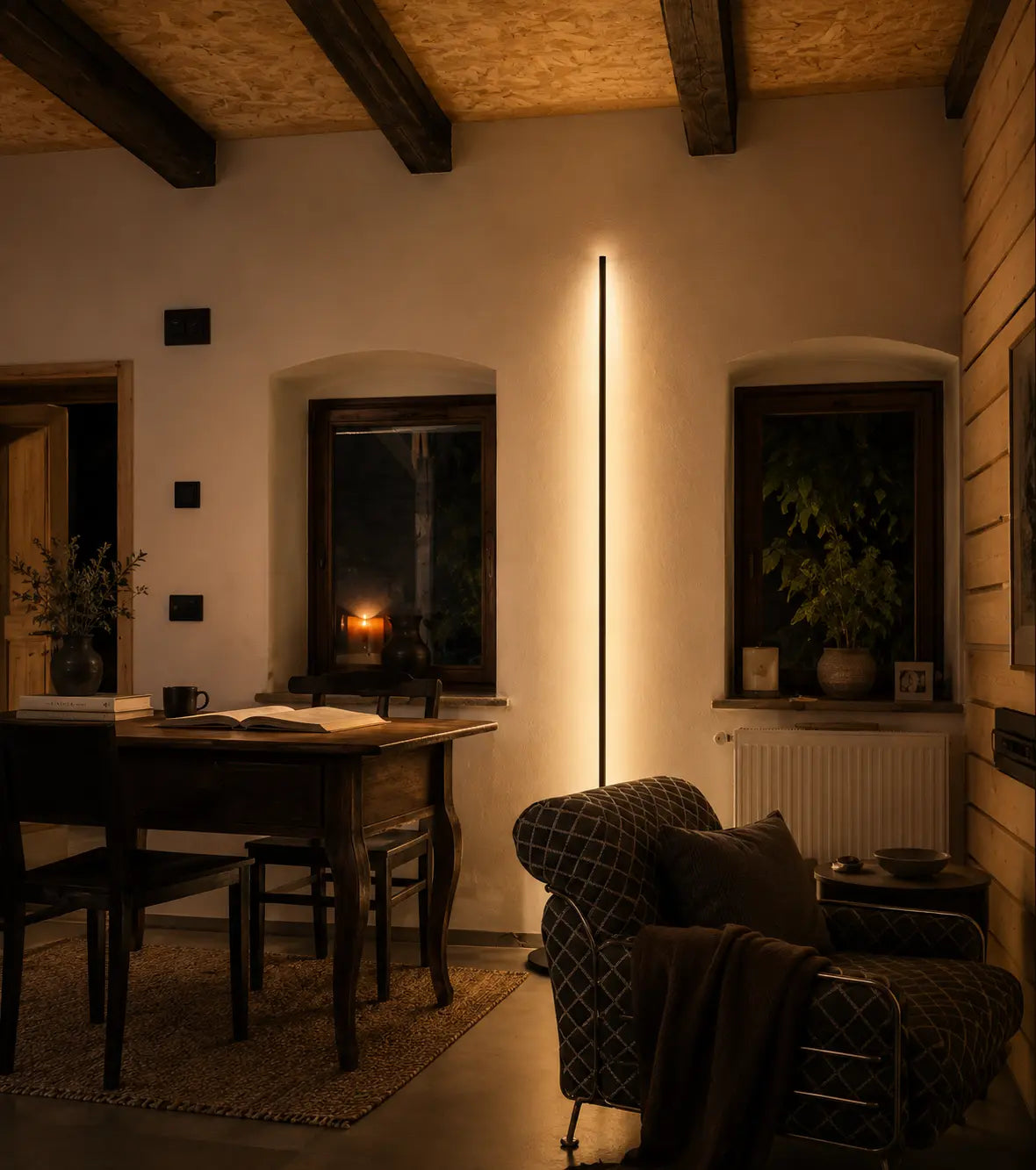
This is where proportion becomes more important than decoration. A small light placed too high can make a wall appear nervous, while a low source may leave the ceiling without relation to the rest of the room. A tall vertical element near a wall can give the eye a measure between floor and ceiling, but only if its scale is considered beside the surrounding planes. The distance between object, wall and furniture decides whether the light belongs to the room or merely occupies it.
An earlier journal text, Light Set to the Pace of a Room, considered how illumination can follow the tempo of occupation. The present point is narrower. The most important moments in a daily lighting rhythm are often the edges between uses: closing a laptop, preparing a table, leaving a corridor partially lit, allowing a room to lose its daytime sharpness without becoming obscure.
Warm light is useful when it changes the room’s level of insistence
Warm light at home is often discussed as if warmth alone could guarantee ease. Colour temperature matters, but it is not a complete answer. A warm source placed badly can still produce glare, expose too much, or make a room feel visually crowded. The value of warmer evening light lies in its capacity to lower the room’s level of insistence when it is used with restraint.
At the end of the day, the eye does not usually need a full inventory of the interior. It needs enough information to trust the space. The outline of a chair, the edge of a table, the vertical limit of a wall, the darker opening of a doorway: these are often sufficient. When every surface is made equally legible, the room remains in a working condition even if no work is being done.
Shadow is not the enemy of this comfort. It gives intervals. It allows the illuminated part of a surface to have an edge and gives the darker part permission to be left alone. Without that interval, warm light can become only a softer version of over-lighting. With it, the room can move toward rest without losing its structure.
This is also where the idea of circadian atmosphere should be handled carefully. A room is not a medical device, and interior light should not borrow scientific language to appear more precise than it is. Still, the human body understands differences in intensity, direction and timing. Evening does not need to imitate day. It can prepare the eye for less effort.
Scale gives the rhythm something to measure against
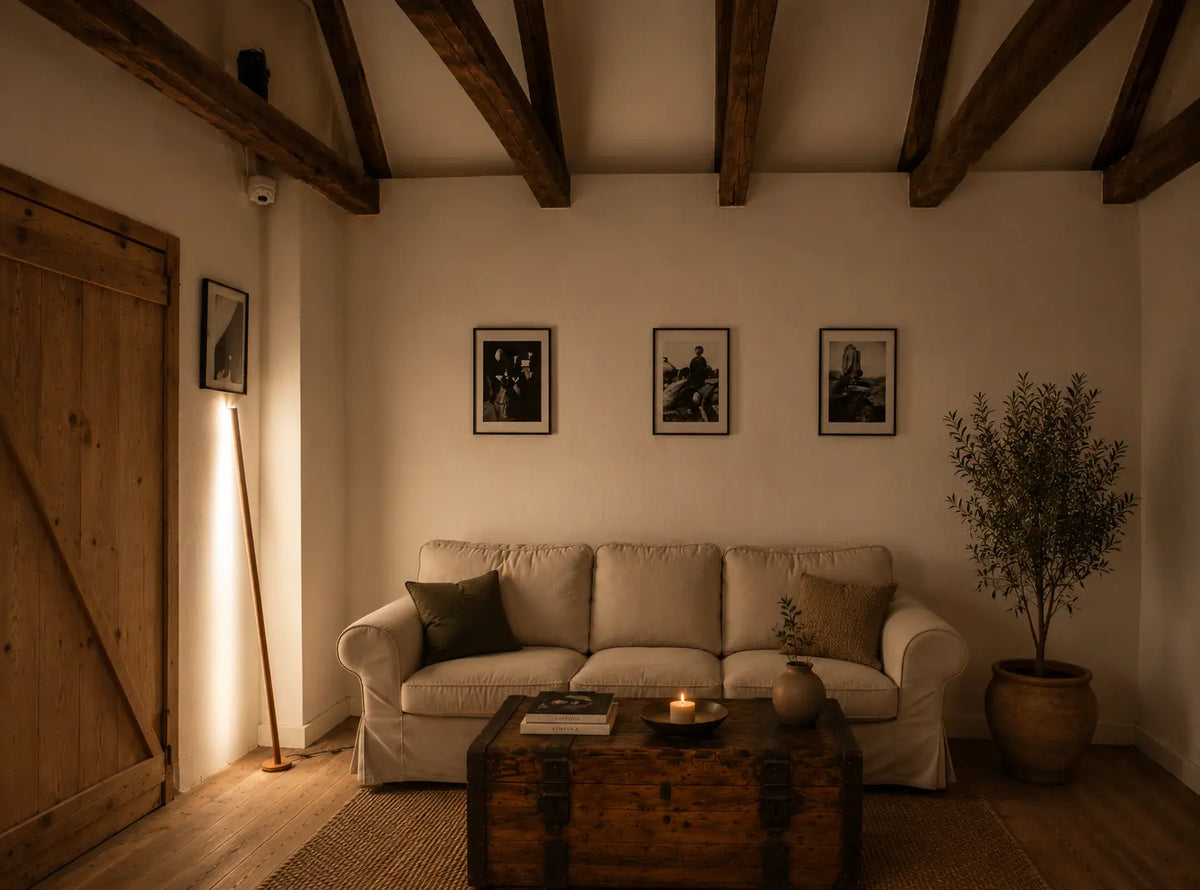
A rhythm is difficult to perceive without reference. In a room, that reference may be the height of a wall, the top of a sofa, the line of a shelf or the vertical distance between floor and ceiling. A light object with enough scale can make the change between hours more legible because the eye reads it against the architecture rather than as an isolated accessory.
For a broader view of how proportion, placement and sculptural presence affect this choice, the guide How to Choose the Right Sculptural Floor Lamp for Your Space follows the same concern from the scale of selection.
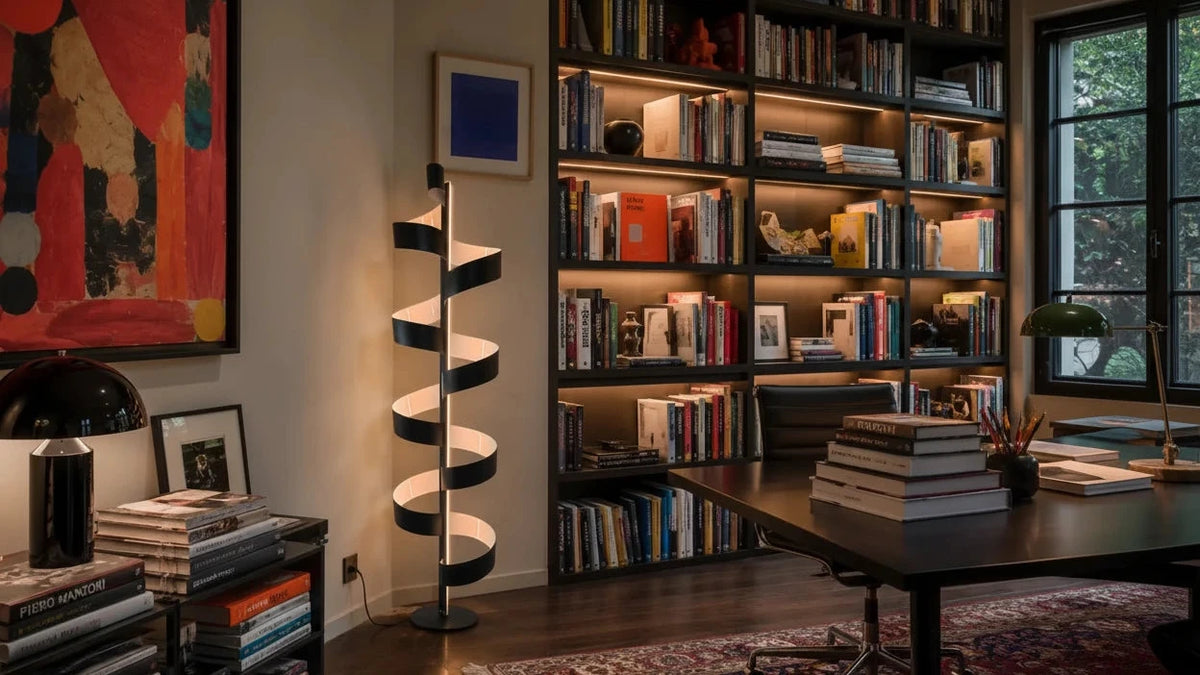
The Gica Contra Floor Lamp 150 can be understood in this way: first as a slender sculptural object, 1500 mm high, and then as a light source with a 2700 K temperature. Those two facts are enough for the present argument. The height gives the object a measurable relation to the wall and to standing furniture. The warm light temperature belongs naturally to evening use, where the room benefits from less visual pressure. Its story, rooted in dialogue between Tommaso Cristofaro and his son Riccardo, remains part of the object’s identity, but the spatial lesson here is simpler: a light can participate in a daily rhythm when its scale and tone help the room change state without theatrical emphasis.
The object is handmade in Europe, and that fact matters less as a claim of rarity than as a reminder that such pieces are judged at the scale of use. A joint, an edge, a surface and a proportion are not abstractions when they stand beside a wall every evening. They are the details through which an interior becomes familiar.
A room remembered well is rarely remembered at one level of brightness. It is remembered by changes: the clearer table in the afternoon, the softer wall after dinner, the path still visible when the rest has quieted. A daily lighting rhythm gives those changes a physical form. It lets the room stop performing one task before the next hour begins.